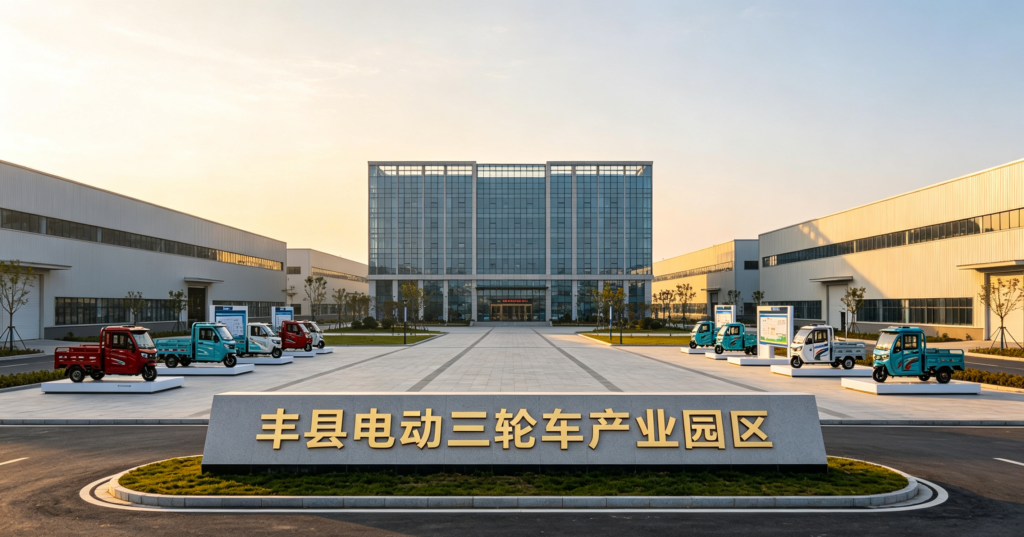
Stepping out of Xuzhou East Railway Station and heading toward the Fengxian Electric Tricycle Industrial Park, the landscape transforms as an ever-growing array of electric tricycles comes into view. Outside village homes sit pastel Macaron-colored enclosed cabins, while deep blue and vibrant red cargo tricycles rumble through the fields. Industrial signs for motor and parts manufacturers line the roads one after another. From humble agricultural runabouts in local farmlands to massive bestsellers shipped across oceans, Fengxian’s electric tricycles are surging onto the global stage with unstoppable momentum.

Independent R&D Powers the Core: From Importing at a Premium to Selling Worldwide
At the Fengxian Electric Vehicle Industrial Park, Wang Zaifeng, general manager of Xuzhou Keya Electromechanical Co., Ltd., has been running off his feet lately, juggling one business trip after another as overseas orders pour in. All customers are asking for the same thing: Chinese-made electric tricycles and core components.
Requiring no fuel, offering lightweight designs, and boasting reliable speed and battery range, Chinese electric tricycles are surging in popularity overseas amid tight global energy supplies and soaring oil prices.
“We independently developed a wireless controller. While traditional wired controllers had 44 wires and a production rate of only 200 units per hour, our wireless controller hits 800 to 900 units an hour—tripling our efficiency while raising quality by two percentage points. It’s an absolute bestseller in European markets,” Wang noted. He added that overseas orders for this controller have become so overwhelming that they are forced to turn away some international requests just to ensure on-time delivery.
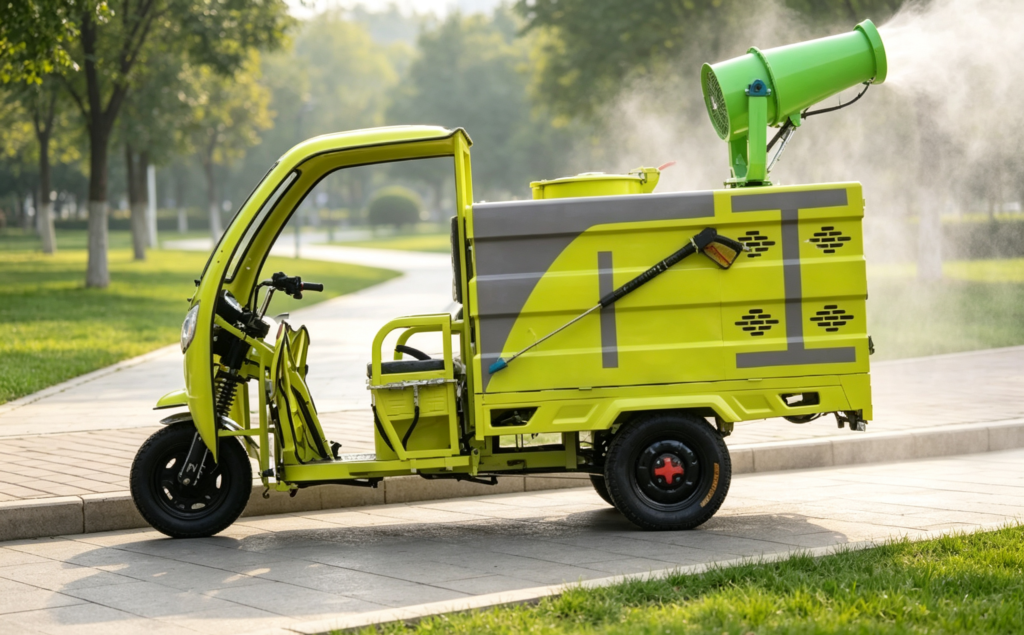
According to Wang Zaifeng, Keya’s independently developed controllers are now exported to nearly 20 countries and regions, including the United States and Turkey. “We used to spend hundreds or thousands of yuan importing controllers from abroad; now it’s foreigners coming to us to place orders, and we have more requests than we can possibly handle,” he said with immense pride.
On overseas social media platforms, numerous influencers have shared videos of their online electric tricycle purchases, routinely racking up hundreds of thousands of views. The footage captures American residents cruising neighborhoods in their tricycles, Southeast Asian farmers zipping around making deliveries, and young people joyriding down the streets of New York.
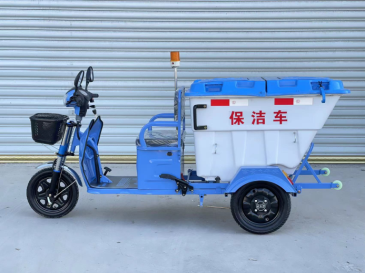
To meet diverse overseas demands, local enterprises in Fengxian have rolled out tailored “private customizations.” Xu Naixu, general manager of foreign trade at Jiangsu Hanbang Vehicle Industry Co., Ltd., noted that the company independently developed patented suspension seats designed to seamlessly adapt to complex road conditions in regions like South America and Southeast Asia, significantly enhancing ride comfort. Additionally, their custom-designed automatic mechanical unloading system saves local farmers massive amounts of labor and time during tropical crop loading and unloading.
Xu explained that thanks to these product upgrades and export overhead, even though the dump tricycle sells for nearly five times its domestic price in South American markets, it remains a hot commodity. “This dump tricycle sells for about 6,000 RMB domestically, but it fetches 30,000 RMB in South America,” Xu proudly shared, gesturing with his fingers.
Statistics show that from January to May 2026, Fengxian’s self-operated electric tricycle export value reached 390 million RMB, marking a 99.3% year-on-year surge, with cumulative export volume surpassing 3 billion RMB.
Full-Chain Synergy Boosts Efficiency: Sourcing All Vehicle Parts in Half an Hour
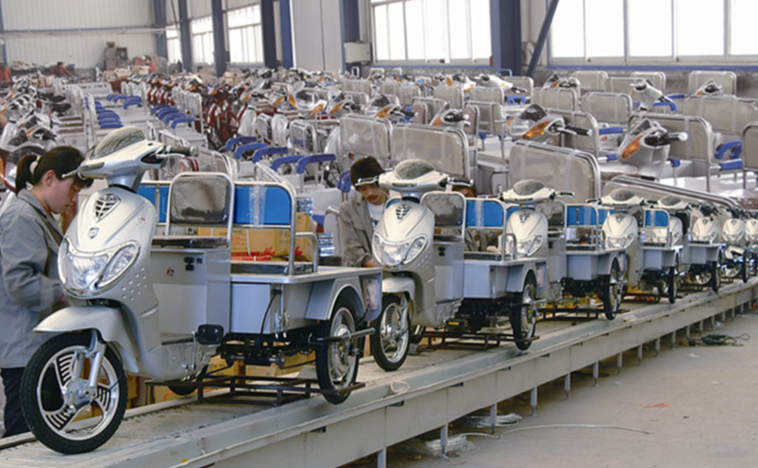
While core technology serves as the engine of the industry, a complete industrial ecosystem forms the true competitive edge of Fengxian’s electric tricycle sector. Within the Fengxian Electric Tricycle Industrial Park, the “half-hour procurement circle” has long been a golden trademark: every single component needed to assemble an electric tricycle can be fully sourced within a 30-minute drive.
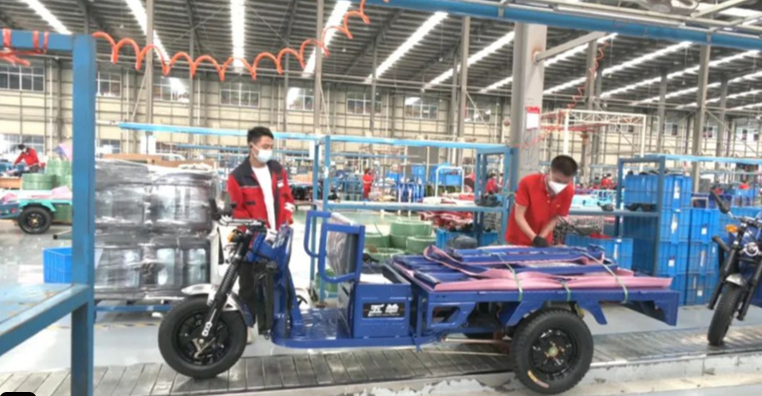
Backed by this integrated supply chain, manufacturers can build entire vehicles right inside the park while achieving intelligent, high-efficiency production:
- At Xuzhou Nanpu Electromechanical Co., Ltd., a brand-new motor rolls off the production line every 12 seconds.
- In the welding workshop of Jiangsu Hanbang Vehicle Industry, frame and chassis production is handled entirely by robots, producing a qualified chassis in just 60 seconds.
- At Jiangsu Zhufeng Electromechanical Co., Ltd., workers install headlights and mount tires to fully assemble a vehicle in a mere 90 seconds.
Thirty-seven-year-old Yan Qiuli, a line supervisor at the Hanbang workshop, sports light red hair and a neat, stylish manicure, yet handles assembly tasks with crisp efficiency. Living just a short distance from the factory, she successfully transitioned to the production floor after a three-week training program. Learning that the electric tricycles she helps build are shipped all the way overseas brings a deep sense of pride to her face: “I never imagined that vehicles built by ordinary workers like us could travel to such distant places.”
As a Hanbang executive remarked lightheartedly, nearly every household in Fengxian has someone like Yan working in the electric tricycle industry—whether it’s an immediate family member, a relative, a friend, or a classmate. “Almost every household understands a bit about electric tricycles; it has simply become a part of daily life here.”
Grouping Up to Expand Global Footprints: Small Vehicles Adapt to Diverse Large-Scale Scenarios
From a single screw to a fully assembled vehicle rolling off the line, an integrated industrial system not only creates outstanding cost and efficiency advantages, but also lays a solid foundation for Fengxian’s electric tricycle industry to go global.
According to Zhang Tianlin, head of the Fengxian Electric Vehicle Industry Association and general manager of Xuzhou Zhibo Locomotive Co., Ltd., the secret to going global lies in two major strengths: “First, the local government has built a comprehensive industrial platform—taking a stroll around Fengxian allows you to source an entire vehicle in a single day. Second, the industry association organizes member companies to venture abroad together, conducting targeted collaborative upgrades and modifications based on the use cases of different countries.”
Breaking away from the traditional perception that electric tricycles are only meant for hauling cargo or carrying passengers, Fengxian’s manufacturing capabilities have long surpassed conventional application scenarios. Li Zhigang, general manager of Xuzhou Beiyu Intelligent Technology Co., Ltd., showcased the company’s lineup of special-purpose vehicles: “This is the Beiyu Rhino 021 all-terrain border patrol unmanned vehicle. Featuring a six-wheel-drive all-terrain design, it can remotely plan routes and perform 24/7 patrol missions along borderlines. Then there’s the Beiyu Fang 003 explosive disposal robot, which can handle the transfer of 5-kilogram hazardous explosives.” These dual-use military-civilian unmanned vehicles and special equipment, he noted, rely entirely on the comprehensive supporting infrastructure of the Fengxian Electric Vehicle Industrial Park to complete the full research, development, and mass-production lifecycle.
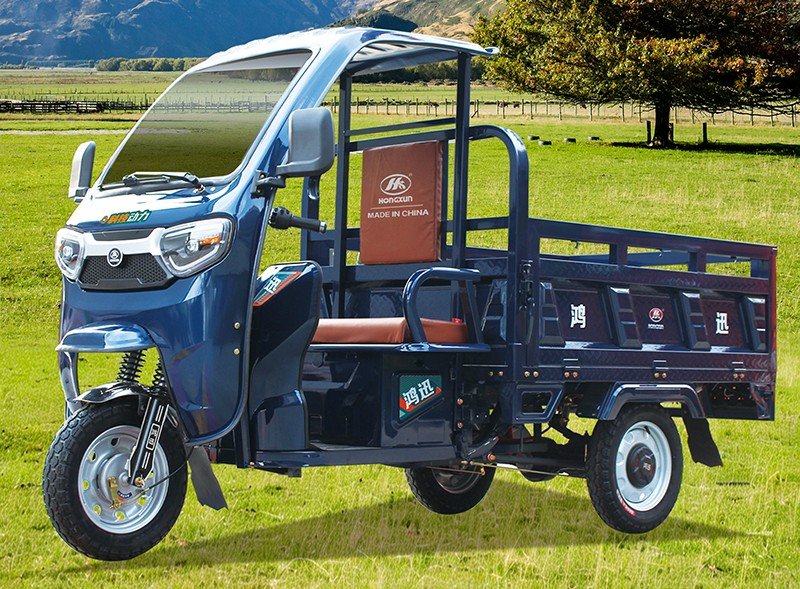
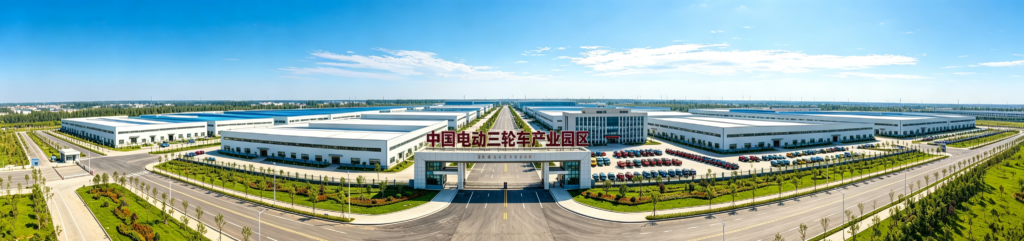
Today, Fengxian has gathered over 1,000 complete-vehicle and component enterprises, establishing itself as China’s largest electric tricycle production base and commanding over 90% of the parts market share.
Industry leaders like Jiangsu Zongshen are driving intelligent upgrades for electric tricycles by incorporating autonomous driving, AI perception, and big data dispatching. These continuous technological breakthroughs are helping Fengxian’s electric tricycles shed the label of low-end manufacturing and step onto the global stage as sophisticated, high-tech products.
In the United States, Chinese electric tricycles are carving out entirely new lifestyles, transitioning from suburban family camping trips to short-distance farm hauling. Across Southeast Asia and Africa, they serve as more than simple commuters—they are vital livelihoods supporting hundreds of millions of people.
As a primary global manufacturing and consumer hub for light electric vehicles, China maintains an unmatched edge in supply chain completeness and cost control. The phenomenon extends far beyond Fengxian:
- Wuxi, Jiangsu: A core 50-square-kilometer zone in Xishan District hosts 6 out of China’s top 10 electric vehicle headquarters or production bases alongside over 600 supporting enterprises.
- Chongqing: In May, Chongqing inaugurated its first overseas new energy vehicle manufacturing plant in Thailand.
- Tailing (Sunra): As one of China’s top three electric motorcycle and tricycle manufacturers, Tailing has already established production and assembly plants in Kenya and Rwanda.
According to China Customs data, annual exports of electric two-wheelers surpassed 26.7 million units in 2025, reaching a total export value of $6.829 billion and maintaining steady, robust growth.
From North American farm operations and Southeast Asian market transport to specialized border patrol applications, China-engineered electric tricycles are continuously expanding their functional boundaries. Fueled by customization and high adaptability, these vehicles are unlocking sustained global growth. Once dismissed as humble local runabouts, the iconic “Sanbengzi” has successfully conquered international markets through a triple pillar of technological innovation, full-chain ecosystems, and collective global expansion.
(By Lin Huihong, Zhang Tao, and Wang Tao, Xinhua Daily·Jiaohuidian Reporters)
